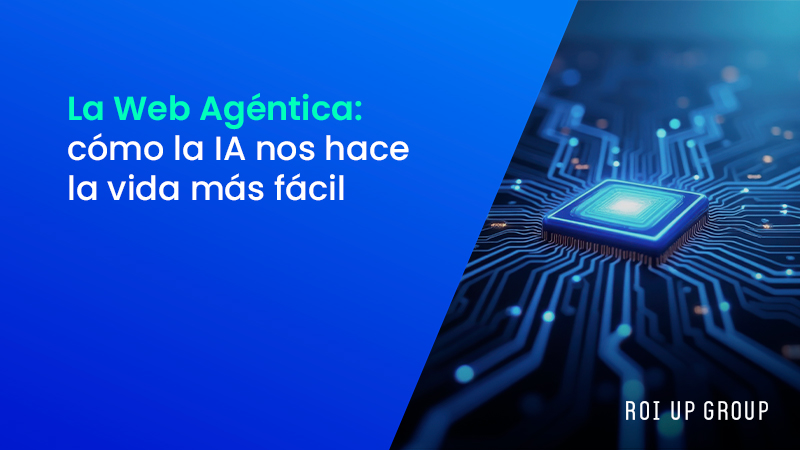
Parallel to other technologies, we are witnessing the rise of the Agentic Web: an evolution of the web in which users no longer interact directly with pages or APIs, but through intelligent agents that think and act like digital assistants.
These agents are capable of:
- Interacting with visitors as advanced chatbots or shopping advisors.
- Acting proactively by personalizing content in real time or triggering alerts.
- Connecting with data, APIs, and other agents to provide more complete responses.
- Pursuing defined objectives, such as improving conversions, reducing costs, or analyzing behaviors.
As a result, they offer benefits such as 24/7 support, innovative user experiences, unlimited scalability, and a significant reduction in operational costs. Furthermore, they open the door to new opportunities — from smart e-commerce to personalized education, automated consulting, or adaptive media that adjusts in real time to each reader.
That said, the Agentic Web will not completely replace traditional websites. Both will coexist within a dual ecosystem: websites will remain essential for attracting traditional traffic and serving as sources of information for search engines and AI, feeding search systems and acting as official sources of information, both externally and for the agentic assistant itself.
Traffic from AI, an additional channel
This new scenario introduces a key concept: traffic from AI. It refers to visits, interactions, and queries generated by AI agents instead of traditional organic search. We are not only talking about human users browsing, but also about AIs that crawl, recommend, and act on behalf of the consumer.
Optimizing content for this channel —through OSO (Organic Search Optimization) strategies and GEO Friendly messaging— is already an essential component of positioning. In the near future, GAIO (GEO for AIs, positioning for AIs) will be as relevant as traditional SEO: much of brand visibility will depend on whether intelligent agents include them in their automatic responses, rather than appearing in a results list (SERPs).
In conclusion, while SEO remains a very important vertical for any digital marketing strategy, it falls short in the new digital ecosystem. Google is no longer the main search channel for users, and channels like TikTok, Instagram, podcasts, and revolutionary AI platforms are key to reaching audiences.
Omnisearch positioning (OSO, Omnisearch Optimization), which means positioning across the entire online channel from any internet-connected device, does not replace SEO — it amplifies and complements it. The key? Not focusing solely on Google positioning, but seeking to position the brand in the user’s mind, whatever their preferred search channel may be.
List of AI publications
- Del SEO al GEO y del GEO al OSO: Omnisearch Optimization (OSO)
- The Agentic Web: How AI Makes Our Lives Easier
- PR GEO Friendly: From Visibility to Prestige
- Synthetic content labeling on social media: everything you need to know
- Sentiment and AI Search Engines: The New Reputational Thermometer
- From Social Media Listening to AI Listening:
- Google Short Videos New Horizons and AI Strategies
- We sponsor Best!n Food 2025: AI, reputation and brands that make a mark
- Google Refine Products
- Google AI Overviews’ expansion in Europe and what it means for your brand